Navigating Mortgage Rates in 2026: Fed's Policy Shifts, Job Market Headwinds, and Leadership Changes
As we close out 2025, the U.S. housing market stands at a pivotal moment. Homebuyers and homeowners alike are eyeing mortgage rates with cautious optimism, hoping for relief after years of elevated borrowing costs. The Federal Reserve's recent policy pivot—ending quantitative tightening (QT), amid a backdrop of rising job losses—signals a potential easing of financial pressures. Yet, uncertainty looms large with the impending replacement of Fed Chair Jerome Powell in May 2026. These developments could shape mortgage rates throughout next year, influencing everything from affordability to refinancing decisions.
In this article, we'll break down these key factors and explore their likely impact on 30-year fixed mortgage rates in 2026. Whether you're preparing to buy, refinance, or simply stay informed, understanding these dynamics can help you make smarter moves in a fluctuating market.
The Fed's End to QT: A Liquidity Lifeline
Quantitative tightening, the Fed's strategy of shrinking its balance sheet by allowing bonds to mature without reinvestment, has been a drag on liquidity since June 2022. Over that period, the central bank withdrew roughly $2.4 trillion from the financial system, contributing to tighter credit conditions and higher interest rates across the board—including mortgages.
That changed dramatically in late 2025. On October 29, the Federal Open Market Committee (FOMC) announced the end of QT, effective December 1. Instead of letting securities roll off, the Fed will now reinvest proceeds from maturing bonds, stabilizing its balance sheet at around $6.5 trillion. This move injects much-needed liquidity—estimated at $13.5 billion in the initial weeks—easing strains in money markets and reducing upward pressure on short-term rates.
For the mortgage market, this is a welcome shift. QT's runoff had indirectly pushed up yields on mortgage-backed securities (MBS), keeping 30-year fixed rates stubbornly high. By halting the drain, the Fed is fostering a more ample reserve environment in banks, which could translate to lower funding costs for lenders. Economists at SVB Asset Management note that this "cautious" end to QT2 (the second QT phase in a decade) prioritizes market stability, potentially paving the way for rates to trend downward without sparking inflation fears.
The immediate market reaction? A modest dip in Treasury yields and mortgage rates, with the 30-year fixed averaging 6.19% as of early December 2025—down from peaks near 7% earlier in the year. Looking ahead, this liquidity boost could help sustain that trajectory into 2026, especially if paired with further Fed rate cuts.
Labor Market Softness: Rate Relief vs. Demand Risks
The U.S. job market, long a pillar of economic strength, showed cracks in late 2025. Through November, employers announced 1.17 million job cuts—a 54% surge from the same period in 2024 and the highest since the 2020 pandemic. Government layoffs, driven by the Trump administration's Department of Government Efficiency (DOGE) initiative, accounted for over 300,000 of those, concentrated in Washington, D.C. Tech followed closely with 153,000 cuts, fueled by AI integration, while retail shed nearly 92,000 roles amid consumer pullback.
November's private payrolls tell a stark story: ADP reported a net loss of 32,000 jobs, the steepest drop in over two years, led by small businesses (under 50 employees) hemorrhaging 120,000 positions. Broader surveys, like Revelio Labs, pegged total losses at 9,000 for the month. Even as weekly jobless claims hit a three-year low in early December, continuing claims neared four-year highs, signaling prolonged unemployment risks.
This softening isn't catastrophic—unemployment hovers around 4.1%—but it's enough to influence Fed policy. A weaker labor market typically prompts rate cuts to stimulate hiring, which in turn lowers mortgage rates. The Fed's September and December 2025 cuts (totaling 75 basis points) were partly a response to these trends. For 2026, persistent job losses could accelerate easing, with the Fed eyeing a "neutral" stance by mid-year. However, if layoffs deepen into a recessionary signal, bond yields might fall faster, pulling mortgage rates below 6% temporarily.
The flip side? Reduced consumer confidence could dampen homebuying demand, keeping inventory tight and supporting home prices despite softer wages. For borrowers, this underscores the value of locking in rates now—before any economic turbulence amplifies volatility.
Fed Chair Candidates: Who Might Steer 2026 Rates?
Jerome Powell's tenure as Fed Chair ends in May 2026, opening the door for President Trump to install a successor aligned with his push for lower rates. Trump has teased his choice, emphasizing candidates who prioritize "cheaper car loans and easier access to mortgages." Betting markets and reports point to a shortlist of five finalists, each with distinct views on monetary policy:
| Candidate | Background | Potential Rate Impact |
|---|---|---|
| Kevin Hassett (Frontrunner, 36% odds) | National Economic Council Director; Trump economic advisor | Dovish lean; favors aggressive cuts to boost growth, potentially driving mortgage rates toward 5.5%-6% by late 2026. |
| Christopher Waller (Fed Governor, 23% odds) | Trump appointee; independent voice on the FOMC | Balanced approach; data-driven easing but inflation-aware, likely stabilizing rates around 6%. |
| Michelle Bowman (Fed Governor) | Vice Chair for Supervision; banking stability focus | Cautious on rapid cuts; could keep a higher-for-longer stance, holding rates in the mid-6% range. |
| Kevin Warsh (Former Fed Governor) | Hawkish during the 2008 crisis; Trump favorite | Favors tighter policy if inflation lingers; risks slower declines, keeping mortgages above ~6.2%. |
| Rick Rieder (BlackRock Fixed Income Chief) | Wall Street veteran; bond-market specialist | Market-oriented; could accelerate easing via QE-lite, benefiting refinancers with sub-6% rates. |
Hassett emerges as the consensus pick, per Bloomberg and Polymarket, due to his White House proximity and alignment with Trump's rate-cut demands. A "shadow chair" announcement early in 2026 could influence markets preemptively, as seen in past transitions. Yet, Senate confirmation and FOMC dynamics (with a hawkish tilt in 2026 voters) may temper aggressive easing. Overall, a dovish appointee like Hassett could shave 0.5% off rates by year-end, enhancing affordability.
Mortgage Rate Trends: A Visual Overview
To contextualize these shifts, consider the 30-year fixed mortgage rate's journey from pandemic lows to 2025 highs. The chart below tracks weekly averages from 2020 onward, highlighting the QT era's upward pressure and recent Fed actions' downward nudge. Data source: fred.stlouisfed.org (MORTGAGE30US)
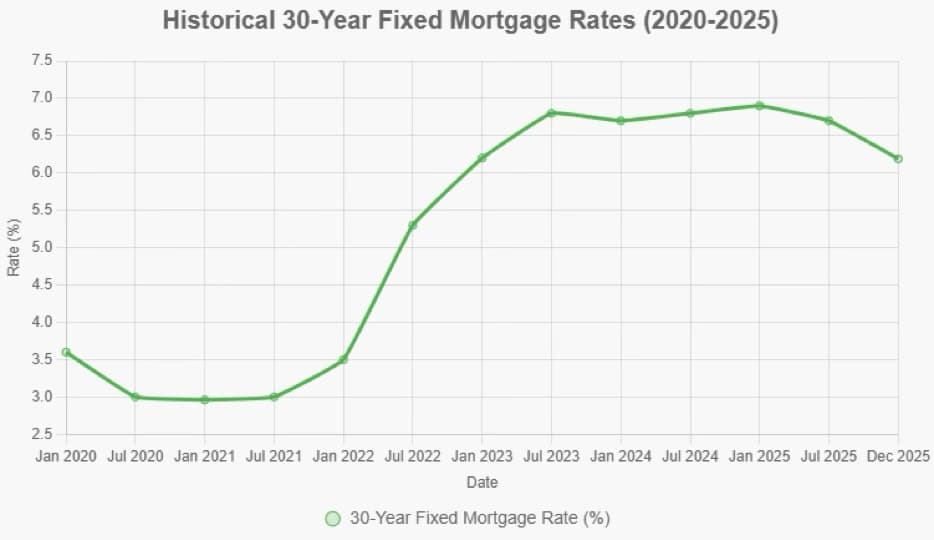
30-year fixed mortgage rate weekly averages (2020-2025) — pandemic-era lows, QT-driven highs, and late-2025 easing. Source: Freddie Mac PMMS / FRED MORTGAGE30US.
This line chart illustrates the dramatic plunge to historic lows in 2021 (driven by pandemic-era QE), the sharp 2022-2023 climb amid QT and inflation fights, and the 2025 stabilization around 6.2-6.9% following Fed cuts. Data sourced from Freddie Mac's Primary Mortgage Market Survey.
2026 Outlook: Modest Relief, But No Return to Sub-3% Days
Forecasts for 2026 paint a picture of gradual improvement, not a boom. Experts like the Mortgage Bankers Association (MBA), Fannie Mae, Redfin, and Zillow converge on an average 30-year fixed rate of 6.0-6.5%, down from 2025's 6.6-6.8%. Key drivers:
Fed Cuts and QT's End: Expect 50-100 basis points in total cuts, pulling rates toward 6.1-6.3% by mid-year.
Job Market Softness: Continued losses could accelerate easing, but a recession might spike volatility.
New Chair Influence: A dovish pick like Hassett boosts odds of sub-6% dips, while hawks like Warsh cap declines.
Zillow warns rates "unlikely to fall below 6%" sustainably, citing sticky inflation and bond market dynamics. Redfin echoes this, projecting a low-6% range amid neutral Fed policy. For buyers, this means monthly payments on a $400,000 loan could ease by $100-150 versus 2025 peaks—enough to unlock pent-up demand without crashing prices.
Final Thoughts: Positioning for a Balanced 2026 Market
The convergence of QT's end, labor market cooling, and Fed leadership transition sets the stage for mortgage rates to ease modestly in 2026, likely averaging 6.2-6.4%. This won't rewind the clock to 2021's sub-3% era, but it offers breathing room for first-time buyers and refinancers eyeing savings.
Ready to act before the next rate move?
Get pre-approved in under 1 hour and compare programs side-by-side—before the spring market heats up.
Get Pre-Approved Now